Introduction
Home loans are a way to buy a house. They help people own homes and build long term wealth. Home loans can be complex. They do not have to be. This guide will help you understand home loans in a way.
This guide is designed to be easy to read and understand. It covers the basics of home loans including the types of loans how to apply and how to save money. We want to help you make choices when it comes to your home loan
1.what is home loan?
Basic Definition
Home loan is the loan you use to buy a house. The bank or lender holds the home as security until you repay the loan.
Key Elements
- The amount you borrow is called the principal.
- The interest is the cost of borrowing money.
- Tenure is how long you have to repay the loan. This is usually 15 to 30 years
- . Your monthly payment includes principal, interest, taxes and insurance.
Why mortgages matter
- Home loan helps you buy a home without paying all the money upfront.
- They give you profits, which means you can use the money to invest in things.
- You may also get tax advantages, which means you can save money on your taxes.
-
Types of Home Loans
Fixed Rate Mortgage
The fixed-rate mortgage is one where the interest rate is constant during the entire duration of the mortgage contract. This is important in that your monthly payments will be consistent throughout.
Benefits
- Your payment will always remain the same so you can plan your budget.
- You do not have to worry about your interest rate going up.
- You have long-term security, which means you know how much you will pay each month.
Drawbacks
- The interest rate may be higher than types of loans.
- If interest rates go down you may be stuck with a rate
Adjustable-rate mortgage
- An adjustable rate mortgage starts at a fixed interest rate but it can change over time.
Benefits
- Your monthly payments may be lower at first
- . This type of loan can be good if you only plan to own the house for a time.
Risks
- Your interest rate may go up over time which means your monthly payments may increase.
- You may not be able to predict what your payments will be each month.
FHA Loans
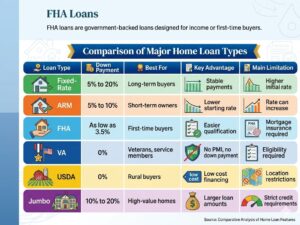
FHA loans are government-backed loans designed for income or first-time buyers.
📊 Table 1: Comparison of Major Home Loan Types |
|||||||||||||||||||||||||||||||||||
|
Features
- Down payment, often 3.5%
- Flexible loan requirements
Limitations
- Mortgage insurance required
- Loan limits apply
VA Loans
- VA loans are available to service members and veterans.
Benefits
- No down payment
- No mortgage insurance
- Competitive rates
USDA Loans
- USDA loans are designed for suburban buyers and rural.
Highlights
- Zero down payment and Income restrictions apply.
Jumbo Loans
- Used for high-value properties exceeding limits.
Considerations
- Higher credit requirements
- Larger down payments
3.Mortgage Interest Rates
How Rates Work
Interest rates determine how much you pay over time. Even small differences significantly impact the cost.
Factors Affecting Rates
Credit score:
a higher score lowers rates
Loan term: shorter terms are often cheaper
Market conditions: inflation,
Federal Reserve policies
Down payment: larger payments reduce risk
Fixed vs Variable Rates
- rates: stable and predictable
- Variable rates: fluctuate, with a balance of risk and reward
4.Loan Terms and Structures
Common Loan Terms
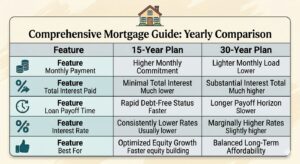
- 30-year loans: monthly payments, higher total interest
- Higher Payments for 15-year Mortgages = Lower Interest Costs
Amortization Explained
Amortization Defined
Payments are spread out over time with amortization.
Early payments have more interest and late payments have more principal..
-
Down Payments
- Standard Requirements
- Mortgages: 5% to 20%
- FHA Loans: As little as 3.5%
- VA and USDA Loans: Zero Percent
Advantages of a Larger Down Payment
- Lower monthly payments
- Reduced interest costs
- Avoid private mortgage insurance
-
Credit Score Importance
Score Ranges
- Excellent: 740+
- Good: 670-739
- Fair: 580-669
- Poor: Below 5
Impact on Mortgage
- Determines eligibility
- Affects interest rate
- Influences loan term
Improvement Tips
- Pay bills on time
- Reduce debt
- Avoid credit inquiries
-
Debt-to-Income Ratio (DTI)
Definition
DTI compares debt payments to income
.
Lenders use it to assess repayment ability
Ideal Ratios
- Below 36%: optimal
- Up to 43%: acceptable for loans
8.Pre-Approval Proces
What Is Pre-Approval?
A lender evaluates your profile and provides a conditional loan offer
Benefits
- Clarifies budget
- Strengthens offers
- Speeds up closing
Required Document
- Income statements, pay stubs, tax returns
- Credit history
- Bank statements
9.The Mortgage Application Process
Step-by-Step Overview
- Pre-approval: review
- Home search: property selection
- Loan application: submission
- Underwriting: risk assessment
- Closing: final agreement
-
Closing Costs
What Are Closing Costs?
Fees are paid at finalization
2% to 5% of the loan value
Common Fees
- Loan origination
- Appraisal
- Title insurance
- Legal fees
Cost Reduction Strategies
- Compare lenders
- Negotiate fees
- Request seller contributions
-
Private Mortgage Insurance (PMI)
When PMI Applies
PMI is required when the down payment is than 20% on conventional loans
Key Points
- Adds to cost
- Can be removed once equity reaches 20%
12. Refinancing Options
What Is Refinancing?
Refinancing replaces an existing mortgage with an one usually to improve terms.
Reasons to Refinance
* interest rates
* Shorten loan term
* Access home equity
Types of Refinancing
*Rate-and-term refinance
*Cash-out refinance
13.Home Equity and Its Use
Definition
Equity is the difference between property value and loan balance.
Uses
* Home improvements
*Debt consolidation
* Emergency funds
Common Mortgage Mistakes
Frequent Errors
* Overborrowing
* Ignoring loan cost
* Skipping pre-approval
* Not comparing lender
How to Avoid Them
* Plan budget carefully
* Understand terms fully
*Seek advice
-
Tips for First-Time Buyers
Practical Advice
* Start saving early
* Improve credit score
* Research loan options
* Get pre-
Smart Buying Strategies
*choose affordable homes
*Consider long-term needs
*Avoid emotional decisions
16.Current Trends in U.S. Mortgage Marke
Rising Interest Rates
Higher rates impact affordability
. Require strategic planning.
Digital Mortgage Platforms
online applications
, faster approvals and improved accessibility.
Flexible Loan Options
lenders offer tailored solutions catering to diverse borrowers.
-
Choosing the Right Lender
Factors to Consider
*Interest rates
* Fees and
closing costs
* Customer service
* Loan flexibility
Comparison Tips
* Request quotes
*Analyze total loan cost, not monthly payment
* Check reviews and ratings
18. Long-Term Financial Planning
Budgeting for Ownership
*Maintenance costs
*Property taxes
* Loan flexibility
* Insurance
Building Wealth Through Estate
* Appreciation over time
* Rental income potential
* Equity growth
-
Advantages of Homeownership
Key Benefits
* Stability: no rent increases
*Investment growth
*Tax deductions
Final Thoughts
When used and managed well, home loans can be a tool for building long-term wealth and, ultimately financial security. By learning the basics of comparing options and making plans, borrowers can jump-start decisions that will benefit them for decades.
Diving into this guide grants you a systematic and helpful foundation to positively, clearly, and successfully work through the process of home loans.