
Equity Shares vs Preference Shares: Key Differences Explained (2026)
By Javeed Dhillon — Investment Educator, 12+ years | 📅 May 2026 |
Description
Discover the key differences and benefits of Equity Shares and Preference Shares in this informative guide by Javeed Dhillon.
1. Equity Shares — Definition & Core Features
Equity shares — also called ordinary shares or common shares — are the backbone of any company’s capital. Buy one and you become a co-owner, proportional to how many you hold.
Per SEBI’s Investor Education Framework, equity shares carry three foundational rights:
- Vote — at AGMs, on board elections, mergers, dividend approvals
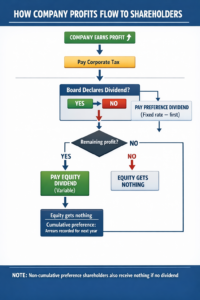
- Dividend — variable, declared at board’s discretion, paid after preference shareholders
- Residual claim — last in line during liquidation, but with unlimited upside if the company thrives
The residual nature is what makes equity unique. Shareholders own what’s left after every obligation is settled. In good years, that’s enormous. In bad ones, it’s nothing.
2. Types of Equity Shares
|
Type |
What It Is |
Who Gets It |
|
Ordinary Shares |
Standard equity — full voting, variable dividend |
General public via stock exchange |
|
Bonus Shares |
Free additional shares from company reserves |
Existing equity shareholders only |
|
Rights Shares |
New shares at a discount before public offering |
Existing shareholders get first right |
|
Sweat Equity |
Non-cash shares for intellectual contribution |
Directors and key employees |
3. Preference Shares — Definition & Core Features
Preference shares sit between equity and debt — a true hybrid. As the NSE India Investor Education portal describes them: instruments that offer the certainty of a fixed return with the legal standing of share capital.
What that means practically:
- Fixed dividend rate set at issuance (e.g., 9% of face value)
- Dividend paid before equity shareholders — always
- Capital repaid before equity in liquidation
- Typically no voting rights (narrow exceptions under Companies Act, 2013 — Section 47)
- Can be redeemable, convertible, or perpetual depending on issue terms
4. Types of Preference Shares
|
Type |
Key Feature |
Risk for Investor |
|
Cumulative |
Unpaid dividends accumulate; cleared before equity gets anything |
Lower — arrears protected |
|
Non-Cumulative |
Skipped dividends are gone permanently |
Higher — no recovery on missed years |
|
Convertible |
Can convert to equity shares after a set period |
Moderate — upside via conversion |
|
Non-Convertible |
Cannot convert; fixed return only |
Stable — predictable, no growth |
|
Redeemable |
Company buys back shares after a term (e.g., 7 years) |
Low — capital returned |
|
Irredeemable (Perpetual) |
No maturity date; held indefinitely |
Medium — exit via secondary market only |
|
Participating |
Fixed dividend + share in surplus profits |
Lower — extra upside possible |
|
Non-Participating |
Fixed dividend only — no share in surplus |
Moderate — capped returns |
5. Master Comparison Table
Targeting Google Featured Snippet: “difference between equity shares and preference shares”
|
Feature |
Equity Shares |
Preference Shares |
|
Legal basis |
Companies Act 2013, Sec 43 |
Companies Act 2013, Sec 43 & 55 |
|
Ownership |
Full ownership |
Limited ownership, no control |
|
Voting rights |
Yes — full |
No (except specific circumstances) |
|
Dividend |
Variable — based on profit |
Fixed — predetermined rate |
|
Dividend priority |
Paid after preference |
Paid before equity |
|
Liquidation claim |
Last (residual) |
Before equity, after creditors |
|
Capital appreciation |
High potential |
Minimal |
|
Risk level |
Higher |
Lower than equity |
|
Convertible? |
No |
Some types convertible to equity |
|
Redeemable? |
No |
Yes (redeemable types) |
|
Bonus shares eligible? |
Yes |
No |
|
Included in market cap? |
Yes |
No |
|
Suitable investor |
Growth-focused, risk-tolerant |
Income-focused, risk-averse |
|
Return type |
Uncapped |
Capped (fixed %) |
6. Dividends, Voting Rights & Liquidation Priority
Dividends
Equity: No fixed rate. Board declares dividends annually — or not at all. In a loss year, zero. In a record year, potentially 40–60%+. Fully variable in both directions.
Preference: Rate locked at issuance. A 9% preference share on ₹100 face value pays ₹9/year — regardless of whether the company earned ₹1 crore or ₹100 crore (subject to profit availability).
Critical nuance per SEBI guidelines: Preference dividends are NOT bond interest. They’re still discretionary in a zero-profit year. Cumulative types preserve arrears; non-cumulative types do not.
Voting Rights
Equity: One share, one vote — typically. Dual-class structures exist in some listed tech companies globally, but standard equity carries full governance participation.
Preference: No vote under Companies Act, 2013, Section 47 — except when:
- (a) Dividends are 2+ years in arrears, or
- (b) A resolution directly affects preference share terms
Liquidation Priority
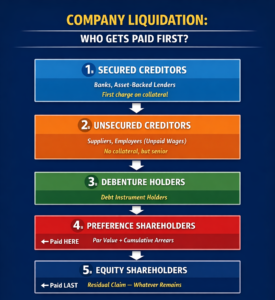
Who gets paid first when a company winds up — per the Insolvency & Bankruptcy Code (IBC), 2016, Section 53:
- Secured Creditors — Banks, asset-backed lenders (first charge on collateral)
- Unsecured Creditors — Suppliers, employees with unpaid wages
- Debenture Holders — Debt instrument holders
- Preference Shareholders ← paid here (par value + cumulative arrears)
- Equity Shareholders ← residual claimants, often receive ₹0 in distressed cases
7. Pros & Cons — Both Share Types
Equity Shares
|
✅ Advantages |
❌ Disadvantages |
|
Unlimited capital appreciation |
No guaranteed dividend |
|
Full voting rights — governance control |
Last in liquidation queue |
|
Eligible for bonus & rights shares |
High price volatility |
|
Liquidity — actively traded on NSE/BSE |
Dilution risk when new shares issued |
|
Long-term wealth creation engine |
Requires ongoing research |
Preference Shares
|
✅ Advantages |
❌ Disadvantages |
|
Fixed, predictable dividend income |
No voting rights (normally) |
|
Paid before equity shareholders |
Dividend not legally guaranteed |
|
Lower price volatility |
No share in surplus profits (most types) |
|
Capital protection via liquidation priority |
Minimal capital appreciation |
|
Cumulative types protect missed dividends |
Inflation erodes fixed return over time |
|
Convertible types offer equity upside option |
Lower secondary market liquidity |
8. Real Examples Table (India & Global — 2026)
|
Company |
Share Type |
Dividend / Return |
What Happened in 2026 |
Lesson |
|
Tata Motors (NSE) |
Equity |
Variable |
EV segment drove ~52% stock appreciation in FY2026; equity holders benefited massively |
Equity rewards long-term conviction in growth stories |
|
Infosys (NSE) |
Equity |
₹21/share declared FY2026 |
Consistent dividend + 18% capital gain; equity outperformed most fixed instruments |
Blue-chip equity: growth + income combo |
|
HDFC Ltd (legacy preference) |
Redeemable Preference |
9.5% fixed |
Preference holders received full par value + arrears on redemption in 2026 |
Redeemable preference = predictable exit |
|
Reliance Industries |
Rights Issue (equity) |
Issued at 14.3% discount |
Existing equity shareholders got first access; non-participants diluted |
Rights issues reward loyal equity holders |
|
Series A Startup, South Asia |
Convertible Preference |
8% fixed + conversion right |
Founders offered convertible preference to early investors — fixed return during risky growth phase |
Convertible preference balances risk for early-stage investors |
Sources: NSE India disclosures, company annual reports, SEBI filings FY2025–26. Approximate figures used for illustration.
9. Which Should You Choose? — 2026 Decision Framework
Three questions. Honest answers. Your decision.
Q1: Do you need income now or growth later?
- Need stable income → Preference shares
- Building wealth over 5–10 years → Equity shares
Q2: Can you handle price swings without panic-selling?
- Yes → Equity shares
- No → Preference shares
Q3: Do you want a say in how the company is run?
- Yes → Equity shares only
- Don’t care → Either works
|
Investor Profile |
Recommended |
Why |
|
Retiree, monthly income needed |
Cumulative Preference |
Fixed payout, arrears protected |
|
28-year-old salaried professional |
Equity (diversified) |
20+ year compounding runway |
|
Conservative portfolio builder |
70% equity + 30% preference |
Growth anchor + income buffer |
|
Early-stage startup investor |
Convertible Preference |
Fixed downside, equity upside option |
|
Corporate treasury manager |
Redeemable Preference |
Defined return + capital return date |
10. Expert Citations & Regulatory References
|
Authority |
Source |
Relevance |
|
Companies Act, 2013 |
Section 43 — Classification of share capital |
Legal definition of equity vs preference shares |
|
Companies Act, 2013 |
Section 47 — Voting rights |
When preference shareholders can vote |
|
Companies Act, 2013 |
Section 55 — Redemption of preference shares |
Rules on redeemable preference shares |
|
SEBI (Investor Education) |
sebi.gov.in/investor-education |
Retail investor guidance on share types |
|
NSE India |
nseindia.com/invest/resources |
Educational resources on equity instruments |
|
BSE India |
bseindia.com |
Listed company preference share disclosures |
|
IBC, 2016 |
Section 53 — Liquidation waterfall |
Priority order during company wind-up |
|
RBI Circular (2025) |
Hybrid instrument classification guidelines |
Preference shares as hybrid capital instruments |
All citations are publicly accessible. Readers are encouraged to verify directly from official government and SEBI portals.
11. FAQs
What is the difference between equity shares and preference shares?
Equity shares give ownership, voting rights, and variable dividends. Preference shares give fixed dividends and payment priority — but no voting rights in most cases.
Which is riskier — equity or preference shares?
Equity shares are riskier. Dividends aren’t fixed and equity holders are last paid in liquidation. Preference shares offer lower risk but capped returns.
Do preference shareholders have voting rights in India?
Generally no. Under Companies Act 2013, Section 47, they vote only when dividends are 2+ years in arrears or a resolution directly affects their share terms.
What does “cumulative” mean in preference shares?
Unpaid dividends accumulate year-on-year and must be cleared in full before equity holders receive anything. Non-cumulative shares forfeit unpaid dividends permanently.
Can preference shares be converted to equity?
Only convertible preference shares carry this right. Non-convertible types have no conversion option under any circumstances.
What happens to equity shareholders in liquidation?
They’re paid last — after all creditors, debenture holders, and preference shareholders. In most distressed liquidations, equity holders recover nothing.
Are preference dividends guaranteed by law?
No. Unlike bond interest, preference dividends require the company to have sufficient profits. Cumulative types accumulate unpaid amounts; non-cumulative types forfeit them.
Why do companies issue preference shares instead of bonds?
Preference shares don’t legally obligate fixed payments, don’t raise the debt-to-equity ratio, and don’t require collateral — giving companies more financial flexibility.
What is the Companies Act provision for preference shares?
Sections 43, 47, and 55 of the Companies Act, 2013 govern share classification, voting rights, and redemption rules for preference shares in India.
Are equity shares included in market capitalization?
Yes. Market cap = number of equity shares × current market price. Preference shares are excluded from this calculation.
Conclusion
Equity shares and preference shares aren’t competing products. They’re different tools for different jobs.
If you want to grow wealth over a decade — equity. If you need reliable income with lower risk — preference. If you want both — build a portfolio that uses each deliberately.
The biggest mistake investors make isn’t choosing the “wrong” share type. It’s buying something without knowing what they actually own. That’s when surprises hurt.
Understand the Companies Act provisions. Read the issue prospectus. Know where you sit in the dividend queue and the liquidation hierarchy. Then invest with confidence.
About the Author
Javeed Dhillon is an investment educator and financial content specialist with 12+ years working directly with retail investors, finance students, and SME owners on share market literacy and capital structure decisions. He references SEBI, NSE/BSE guidelines, and the Companies Act throughout his writing to ensure accuracy — not just readability.
This article is for educational purposes only. It does not constitute investment advice. Consult a SEBI-registered investment advisor before making financial decisions.