Scope of Industrial Finance: The Complete 2026 Guide to Funding Industrial Growth
Author: Javeed Dhillon | Published: May 2026 | Category: Industrial Finance, Business Finance, Economic Development
“Industries don’t just run on raw materials and labor — they run on finance. Without it, even the most brilliant industrial idea stays locked on paper.”
Introduction: Why the Scope of Industrial Finance Matters More Than Ever
Imagine a steel manufacturing company in 2026 that wants to install automated production lines, expand its factory floor, and hire 500 skilled workers. The vision is clear. The plan is solid. But without the right financial backbone — the right mix of industrial finance — none of it moves forward.
That’s the real power behind the scope of industrial finance. It’s not just about loans and interest rates. It’s about the entire financial ecosystem that keeps industries alive, growing, and globally competitive.
Industrial finance refers to the organized system of financial resources — short-term, medium-term, and long-term — that industries require to operate, expand, modernize, and innovate. From building factories and procuring raw materials, to acquiring machinery and managing working capital, the scope of industrial financing covers virtually every financial dimension of production and growth.
In this comprehensive guide, you’ll learn exactly what industrial finance includes, its key functions, types, sources, institutions, challenges, and what its future looks like in 2026 and beyond. Whether you’re a student, entrepreneur, economist, or business professional, this article will give you a clear, structured, and expert-level understanding of one of the most critical pillars of economic development.

What Is Industrial Finance? (Definition and Core Meaning)
Industrial finance is the branch of financial management that deals specifically with providing, organizing, and managing funds for industrial enterprises — from small-scale manufacturers to large multinational corporations.
According to classic economic definitions, the term industrial finance is used to denote the organization of various types of finance needed by industries for carrying on activities connected with the production of goods and services. These activities include:
- Construction of buildings and infrastructure
- Purchase and maintenance of machinery
- Procurement of raw materials
- Payment of wages and operational salaries
- Research and development investments
- Technological upgradation and modernization
Unlike personal finance or consumer lending, industrial finance focuses on large-scale capital requirements, longer gestation periods, and sector-specific financial challenges. It is the financial lifeblood that allows industries to not only survive day-to-day operations but also pursue strategic growth.
Key Insight: Finance is considered the life-force of industry. Without adequate financial support, even a well-planned industrial project can collapse before it reaches its potential.
The Scope of Industrial Finance: A Deep-Dive Overview
The scope of industrial finance is extraordinarily broad. It encompasses everything from the moment an industrial venture is conceived to the point where it generates sustained profits. Below is a structured breakdown of what falls within this scope.
1. Capital Formation and Mobilization
The first and most fundamental area in the scope of industrial finance is capital formation — the process of pooling financial resources from various sources (equity, debt, retained earnings, institutional loans) to fund industrial projects.
Capital mobilization involves:
- Issuing shares and debentures to the public
- Borrowing from banks and development financial institutions
- Reinvesting profits back into the business
- Attracting foreign direct investment (FDI)
For example, in 2026, India’s Tata Motors raised a significant tranche of long-term financing to fund its electric vehicle manufacturing expansion, combining equity issuance with development bank loans — a textbook example of industrial capital mobilization.
2. Fixed Capital Financing
Fixed capital refers to the funds used to acquire permanent or long-term assets like land, factory buildings, heavy machinery, and infrastructure.
The scope here includes:
- Term loans from commercial banks and development banks
- Mortgage financing on industrial properties
- Equipment financing and lease arrangements
- Infrastructure bonds for large-scale projects
Fixed capital investments are typically tied to repayment periods of 5 to 25 years, making them the most complex and high-stakes component of industrial finance.
3. Working Capital Management
Working capital is the day-to-day financial fuel of any industrial unit. It covers short-term operational needs such as:
- Buying raw materials and inventory
- Paying factory wages and salaries
- Managing accounts receivable and payable
- Covering utility and logistics costs
Short-term working capital financing — through overdrafts, cash credit lines, trade credit, and bill discounting — is a critical and highly active segment within the scope of industrial finance. Without it, even well-capitalized factories can grind to a halt.
4. Modernization and Technological Upgradation
In the 21st century, the scope of industrial finance has expanded dramatically to include technology financing. Industries must continuously modernize to stay competitive — whether that means adopting AI-driven production, installing energy-efficient systems, or upgrading to Industry 4.0 standards.
Financial instruments supporting modernization include:
- Soft loans from development banks at concessional interest rates
- Green financing for eco-friendly industrial upgrades
- Technology venture funds and innovation grants
- Export refinancing tied to product upgrades
5. Project Finance for New Industrial Ventures
Project finance is a specialized sub-domain within industrial finance. It involves financing new industrial ventures on the basis of the projected cash flows of the project itself, rather than the balance sheet of the promoter.
This is particularly relevant for:
- Power generation plants
- Petrochemical refineries
- Semiconductor fabrication units
- Large infrastructure-linked manufacturing projects
In 2026, project finance is booming globally. According to industry reports, the global project finance market crossed $350 billion in total deal value, with manufacturing and clean-energy projects driving the growth.
6. Rehabilitation and Restructuring Finance
Not every industrial unit thrives. Some face financial distress due to market shifts, mismanagement, or economic downturns. The scope of industrial finance therefore includes rehabilitation financing — structured interventions to rescue and revive viable but struggling industrial units.
This includes:
- Debt restructuring packages from banks
- Government-backed bailout mechanisms
- Special recovery funds managed by development institutions
- Asset monetization strategies
7. Export Finance for Industrial Units
Industrial enterprises engaged in international trade need specialized financial products. Export finance within the scope of industrial finance includes pre-shipment credit (to produce goods for export) and post-shipment credit (to bridge the gap until payment is received).
Institutions like the Export-Import Bank of the United States (US EXIM) and ECGC in India are specifically mandated to support industrial exporters with financing and insurance products.

Types of Industrial Finance
Industrial finance is broadly classified based on the duration and purpose of funding. Here’s a clear breakdown:
| Type | Duration | Primary Use | Common Instruments |
|---|---|---|---|
| Short-Term Finance | Up to 1 year | Working capital, raw material procurement | Cash credit, overdraft, trade credit, bill discounting |
| Medium-Term Finance | 1 to 5 years | Equipment purchase, product expansion, partial modernization | Term loans, hire purchase, lease financing |
| Long-Term Finance | 5 years and above | Factory construction, major machinery, large-scale expansion | Equity shares, debentures, development bank loans, bonds |
Short-Term Industrial Finance
This category handles the immediate, recurring financial needs of an industrial unit. The repayment period is typically under one year, and the cost of raising such finance is relatively lower.
Key features:
- Flexible: Loans can be raised and repaid quickly
- No interference in management
- Often renewable (e.g., cash credit renewed annually)
- Can sometimes serve long-term purposes when continuously renewed
Medium-Term Industrial Finance
Medium-term finance bridges the gap between day-to-day operations and major strategic investments. Industries use it for projects that are not as capital-intensive as long-term investments but still require significant commitment.
Examples include purchasing new production equipment, expanding into a second facility, or digitizing operations.
Long-Term Industrial Finance
Long-term finance is the backbone of industrial expansion. It funds the fixed capital requirements — the permanent assets that define an industry’s production capacity.
Sources include:
- Capital market instruments (shares, debentures, bonds)
- Development Financial Institutions (DFIs)
- Foreign direct investment
- Government infrastructure funds
Sources of Industrial Finance
Understanding the scope of industrial finance also means understanding where the money actually comes from. The major sources can be organized into the following categories:
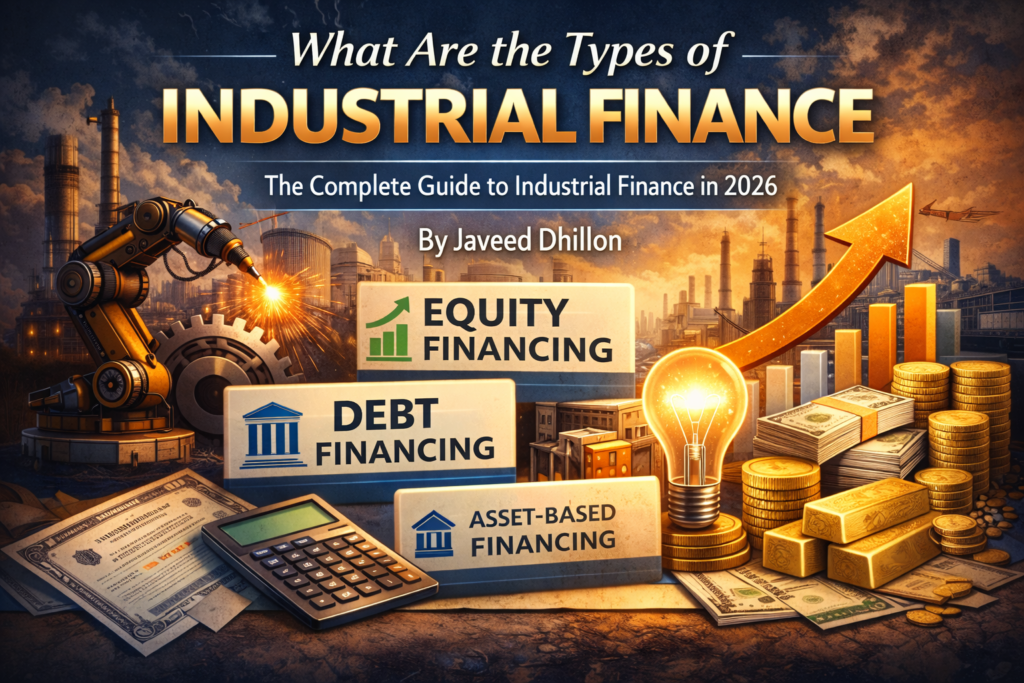
A. Ownership Funds (Equity)
These are funds contributed by the owners of the industrial enterprise. For sole proprietorships and partnerships, this is the owner’s personal investment. For companies, it involves:
- Issuance of equity shares
- Retained earnings and ploughed-back profits
- Premium on share issuance
- Capital reserves
Equity financing does not require repayment but does dilute ownership and shifts some control to investors.
B. Borrowed Funds (Debt)
Debt financing remains the most widely used source of industrial finance worldwide. It includes:
- Commercial Bank Loans: Short to medium-term lending for working capital and equipment
- Debentures: Long-term debt instruments issued to the public with fixed interest payments
- Development Bank Loans: Concessional term lending from specialized institutions
- Foreign Currency Loans: Borrowings in international currency for large projects
C. Development Financial Institutions (DFIs)
These are specialized public-sector institutions established to provide long-term finance to industries, especially in developing economies. Examples include:
- IDBI (Industrial Development Bank of India) — Provides long-term project finance and refinancing
- IFCI (Industrial Finance Corporation of India) — Supports medium and large industries
- SFCs (State Financial Corporations) — Serve small and medium industries at the state level
- KfW (Germany) — One of the world’s most successful development banks, funding industrial modernization
- DFC (U.S. Development Finance Corporation) — Supports industrial projects in strategic markets
D. Capital Markets
Capital markets allow industries to raise large amounts of long-term finance from a wide pool of investors. Instruments include:
- Equity shares (ownership stakes)
- Preference shares (fixed dividend, priority claim)
- Bonds and debentures (debt securities)
- Commercial paper (short-term debt)
E. Government and Institutional Support
Governments play a significant role in industrial finance through:
- Subsidized credit schemes for priority sectors
- Tax incentives and investment allowances
- Export promotion financing
- Sovereign wealth fund investments in strategic industries
Key Functions of Industrial Finance
The scope of industrial finance is best understood through its core functions. These are the activities that industrial finance performs to keep the production engine running.
1. Provision of Fixed Capital
Industrial finance arranges the long-term funds needed to acquire land, construct factories, and install heavy machinery — the permanent infrastructure of industrial production.
2. Provision of Working Capital
It ensures that industries always have sufficient liquidity to purchase inputs, pay workers, and manage the production cycle without disruption.
3. Facilitating Modernization
Industrial finance enables industries to replace outdated equipment, adopt new technologies, and upgrade production processes — keeping them globally competitive.
4. Promoting New Enterprise Formation
It provides the seed capital and startup financing that helps new industrial ventures get off the ground, stimulating entrepreneurship and job creation.
5. Supporting Rehabilitation
When industrial units face financial distress, industrial finance instruments and institutions step in with restructuring solutions to prevent closures and protect employment.
6. Enabling Export Expansion
Through export credit and trade finance instruments, industrial finance helps manufacturers access international markets, boosting foreign exchange earnings and GDP.
7. Balanced Regional Development
Development banks and government financial institutions channel industrial finance to economically backward regions, promoting balanced and inclusive industrial growth.
Institutions in the Scope of Industrial Finance
A wide range of institutions operate within the ecosystem of industrial finance. Each serves a distinct role:
| Institution Type | Examples | Primary Role |
|---|---|---|
| Central Banks | RBI, Federal Reserve, ECB | Monetary policy, credit regulation |
| Commercial Banks | SBI, JPMorgan, HSBC | Working capital, term loans |
| Development Banks | IDBI, KfW, ADB | Long-term project finance |
| Capital Market Bodies | SEBI, SEC | Regulate equity and debt markets |
| Export Finance Institutions | US EXIM, ECGC | Export credit and insurance |
| State/Regional Financial Institutions | SFCs, SIDCs | SME finance at sub-national level |
| International Financial Institutions | World Bank, IFC, ADB | Cross-border industrial development |
Scope of Industrial Finance in the Context of Economic Development
Industrial finance doesn’t operate in isolation — it is deeply embedded in a country’s broader economic development strategy.
Here’s how the scope connects to macro-level outcomes:
- Employment Generation: Financed industries create jobs, reducing unemployment and raising living standards
- GDP Growth: Industrial output directly contributes to national income and GDP
- Technological Progress: Finance-backed R&D drives innovation and productivity gains
- Trade Balance Improvement: Export-oriented industrial finance strengthens a country’s balance of payments
- Infrastructure Development: Industrial projects funded by long-term finance build lasting physical infrastructure
In 2026, countries like India, Vietnam, and Brazil are leveraging industrial finance policy as a strategic tool for economic catch-up — funding domestic manufacturing ecosystems to compete with established industrial powers.
Real-World Example (2026): Green Industrial Finance in Action
Case Study: Reliance Industries’ Green Hydrogen Initiative — 2026
In early 2026, Reliance Industries Limited (RIL) completed the first phase of its massive green hydrogen production facility in Jamnagar, India. The project, valued at over $10 billion, required a sophisticated industrial finance structure:
- Long-Term Debt: $4 billion in green bonds issued to international ESG investors
- Development Bank Loan: $2.5 billion from the Asian Development Bank (ADB)
- Equity Capital: $2 billion raised through a rights issue on Indian capital markets
- Government Subsidy: $500 million in production-linked incentive (PLI) disbursements
- Working Capital Lines: $200 million in revolving credit from a consortium of commercial banks
This example illustrates the multi-layered, multi-source nature of industrial finance at scale. No single instrument or institution could have funded this project alone. The scope of industrial finance — from equity to green bonds to government support — made it possible.
The facility now produces clean hydrogen for export and domestic industrial use, creating 12,000 direct jobs and reducing carbon emissions by an estimated 3 million tonnes annually.
Challenges in the Scope of Industrial Finance
Despite its breadth, industrial finance faces several persistent challenges:
1. Inadequate Long-Term Capital
Many developing economies suffer from a shortage of long-term patient capital. Banks tend to prefer short-term lending, creating a structural mismatch between industry’s needs and available finance.
2. High Cost of Borrowing
Elevated interest rates — especially in inflationary environments — raise the cost of industrial borrowing, squeezing margins and discouraging investment in new capacity.
3. Credit Access Gaps for SMEs
Small and medium-sized industrial enterprises (SMEs) often struggle to access formal industrial finance. Collateral requirements, documentation burdens, and risk perceptions limit their borrowing options.
4. Currency and Exchange Rate Risks
Industries that borrow in foreign currencies are exposed to exchange rate volatility, which can dramatically inflate repayment costs if the domestic currency depreciates.
5. Regulatory and Compliance Complexity
The industrial finance landscape is heavily regulated. Navigating multiple regulatory frameworks — banking regulations, capital market rules, environmental compliance for green finance — adds cost and complexity.
6. Information Asymmetry
Lenders often lack sufficient information about industrial borrowers’ true risk profile, leading to either excessive caution (underfinancing) or mispriced risk (bad loans).
The Future Scope of Industrial Finance (2026 and Beyond)
The scope of industrial finance is evolving rapidly, shaped by four transformative forces:
1. Green and Sustainable Finance
Environmental, Social, and Governance (ESG) criteria are now central to industrial lending decisions. Green bonds, sustainability-linked loans, and climate finance are fast becoming mainstream instruments for funding industrial projects.
2. Fintech and Digital Lending
Technology is democratizing industrial finance. Digital lending platforms, AI-driven credit scoring, blockchain-based trade finance, and tokenized industrial assets are opening new pathways — especially for SMEs previously excluded from formal finance.
3. Geopolitical Reshoring Finance
In 2026, governments worldwide are actively financing the reshoring of strategic industries — semiconductors, pharmaceuticals, critical minerals — back to domestic soil. This creates new demand for specialized industrial finance instruments.
4. Development Finance Institutions 2.0
DFIs are being modernized with expanded mandates, more flexible instruments, and greater private sector co-financing capacity. Germany’s KfW, the U.S. DFC, and the Asian Infrastructure Investment Bank (AIIB) are all scaling up their industrial finance portfolios.
5. Blended Finance Models
Blended finance — the strategic combination of public and private capital — is gaining traction for industrial projects in emerging markets. It uses concessional public money to de-risk investments and attract private industrial financiers.
Summary Table: Scope of Industrial Finance at a Glance
| Dimension | What It Covers |
|---|---|
| Time Horizon | Short-term (≤1 yr), Medium-term (1–5 yrs), Long-term (5+ yrs) |
| Capital Type | Equity, Debt, Hybrid instruments |
| Purpose | Fixed capital, Working capital, Modernization, Rehabilitation, Export |
| Key Institutions | Commercial banks, DFIs, Capital markets, Government bodies |
| Sectors Covered | Manufacturing, Heavy industry, Infrastructure, Energy, Tech |
| Economic Role | Employment, GDP growth, Trade balance, Innovation, Regional development |
| Emerging Trends | Green finance, Fintech lending, Reshoring finance, Blended models |
Conclusion: Industrial Finance — The Engine Behind the Engine
The scope of industrial finance is nothing short of the financial architecture that makes industrial civilization possible. It spans from a small weaving unit in rural Punjab borrowing working capital to buy yarn, to a $10 billion green hydrogen plant raising capital across three continents.
What unites all of this is a simple, powerful truth: industries need finance to function, and economies need industries to grow.
Understanding the scope of industrial finance — its types, sources, institutions, functions, and challenges — gives policymakers, entrepreneurs, investors, and students the tools to make smarter decisions, build better systems, and contribute to sustainable industrial development.
As we move deeper into 2026 and beyond, industrial finance is not just about money. It’s about channeling capital intelligently toward productive, sustainable, and socially valuable industrial activity. The scope has never been broader — and the opportunity to use it wisely has never been greater.
Frequently Asked Questions (FAQs)
Q1. What is industrial finance in simple terms?
Industrial finance is the system of financial resources — loans, equity, bonds, and institutional credit — that industries use to fund their operations, expansion, and modernization.
Q2. What is the scope of industrial finance?
The scope covers fixed capital financing, working capital management, modernization funding, project finance, export finance, and industrial rehabilitation across all sectors of the economy.
Q3. What are the main types of industrial finance?
The three main types are short-term finance (up to 1 year), medium-term finance (1–5 years), and long-term finance (5+ years), each serving distinct industrial needs.
Q4. What are the sources of industrial finance?
Key sources include equity shares, debentures, commercial bank loans, development financial institutions (like IDBI, KfW), capital markets, government schemes, and foreign investment.
Q5. Why is industrial finance important for economic development?
It drives employment creation, GDP growth, technological progress, export expansion, and balanced regional development by ensuring industries have the capital they need to grow.
Q6. What are the main challenges in industrial finance?
Major challenges include inadequate long-term capital, high borrowing costs, limited SME credit access, currency risk, regulatory complexity, and information asymmetry between lenders and borrowers.
Q7. What is the role of development banks in industrial finance?
Development banks like IDBI, IFCI, KfW, and ADB provide long-term concessional loans, technical guidance, and risk-sharing instruments specifically designed to finance industrial projects that commercial banks may avoid.
Q8. How is industrial finance changing in 2026?
In 2026, industrial finance is being reshaped by green/ESG finance, digital lending platforms, geopolitical reshoring incentives, and blended finance models that combine public and private capital.
Q9. What is the difference between working capital and fixed capital in industrial finance?
Fixed capital finances permanent assets (factories, machinery), while working capital covers day-to-day operational costs (raw materials, wages, utilities) — both are essential for a functioning industrial unit.
Q10. Is industrial finance the same as project finance?
Not exactly. Project finance is a specialized sub-set of industrial finance focused on funding discrete projects based on their own cash flows, while industrial finance is the broader term covering all financial needs of industrial enterprises.
AUTHOR
Written by Javeed Dhillon — Finance Educator, Business Strategist, and Economic Development Analyst with over a decade of experience covering industrial finance, development banking, and capital markets across South Asia and global emerging economies.
SEO Keywords Naturally Used: scope of industrial finance, industrial finance definition, types of industrial finance, sources of industrial finance, functions of industrial finance, industrial finance institutions, working capital management, fixed capital financing, development financial institutions, long-term industrial finance, short-term industrial finance, industrial finance in India, project finance, industrial economic development, industrial finance 2026