The Role of Financial Institutions: How Banks, Credit Unions & Investment Firms Power the Global Economy (2026 Guide)
By Javeed Dhillon | Updated: May 2026 |
“Without financial institutions, the modern economy would not simply slow down — it would stop entirely.”
Introduction: Why Financial Institutions Matter More Than Ever
Here is a truth most people never think about: every time you swipe your card, take out a loan, invest in a retirement fund, or even pay your electricity bill online — a financial institution is quietly working behind the scenes to make that happen.
Financial institutions, financial intermediaries, banking systems, capital markets, and monetary policy transmission are not just textbook phrases. They are the living machinery of every economy on earth. They channel idle savings into productive investments, shield businesses from financial risk, enable governments to fund infrastructure, and provide ordinary citizens with tools to build wealth over time.
In 2026, the stakes have never been higher. According to a Finastra global survey, 96% of financial institutions are actively using or planning to implement AI — and the shift from traditional banking to digital-first, AI-powered finance is reshaping the role these institutions play in society. Yet their core purpose has remained unchanged for centuries: to connect people who have money with people who need it, and to do so safely, efficiently, and fairly.
This article is a complete, research-backed guide to understanding the role of financial institutions in the economy, their types and functions, their modern-day challenges, and what 2026 looks like for the industry. Whether you are a student, entrepreneur, investor, or simply a curious reader — this guide was written for you.
What Are Financial Institutions? A Clear Definition
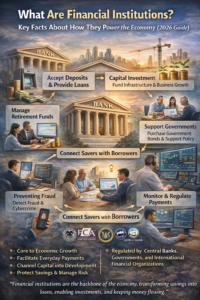
A financial institution is any organization that deals with financial and monetary transactions. This includes accepting deposits, making loans, facilitating investments, currency exchange, and providing insurance. They serve as the bridge — the financial intermediary — between those who have surplus funds (savers) and those who need funds (borrowers and investors).
Financial institutions are regulated by government bodies such as central banks, securities regulators, and insurance commissions. In the United States, this includes the Federal Reserve, the FDIC, the SEC, and the OCC. In the UK, it’s the FCA and the Prudential Regulation Authority. Globally, institutions like the IMF and the World Bank play an overarching supervisory and developmental role.
Types of Financial Institutions
Understanding the types of financial institutions is the first step to understanding how the whole system works. Each type serves a different but interconnected function.
| Type of Financial Institution | Primary Function | Examples |
| Commercial Banks | Accept deposits, issue loans, payment services | JPMorgan Chase, HSBC, Standard Chartered |
| Investment Banks | Capital raising, M&A advisory, securities | Goldman Sachs, Morgan Stanley |
| Credit Unions | Member-owned cooperative savings & loans | Navy Federal Credit Union |
| Insurance Companies | Risk transfer and protection | AIG, Allianz, Prudential |
| Pension Funds | Long-term retirement savings management | CalPERS, UK Pension Fund |
| Microfinance Institutions | Small loans for underserved communities | Grameen Bank, BRAC |
| Development Finance Institutions | Economic development in developing nations | World Bank, ADB, IFC |
| Central Banks | Monetary policy, currency issuance, financial stability | U.S. Federal Reserve, ECB, State Bank of Pakistan |
| Brokerage Firms | Facilitate buying and selling of securities | Charles Schwab, Fidelity |
| Mutual Funds / Asset Managers | Pool and invest capital on behalf of clients | Vanguard, BlackRock |
The Core Roles of Financial Institutions in the Economy
-
Mobilizing Savings and Channeling Investment
One of the most important — and often overlooked — roles of financial institutions is mobilizing savings. Millions of households around the world earn more than they spend in any given month. Left in a mattress or a tin can, those savings produce nothing. Financial institutions transform those idle funds into active economic fuel.
By offering savings accounts, fixed deposits, bonds, and mutual fund schemes, banks and asset managers collect these scattered savings and pool them together. That pooled capital is then deployed — as loans to small businesses, mortgages for first-time homebuyers, or corporate bonds for infrastructure projects.
According to World Bank research, financial sector development promotes economic growth by increasing the savings rate, mobilizing capital, and optimizing the allocation of resources toward their most productive uses. In simpler terms: more savings in the financial system means more investment, which means more jobs and higher incomes over time.
Real-World Example (2026): In Pakistan, the State Bank of Pakistan’s National Savings schemes collected over PKR 4.8 trillion in public savings in FY2025, which were channeled into government development programs, infrastructure, and national debt management — directly funding schools, roads, and hospitals.
-
Financial Intermediation: Connecting Savers and Borrowers
Financial intermediation is the heartbeat of any banking system. Banks and other financial institutions act as go-betweens: they borrow from savers (by accepting deposits) and lend to borrowers (businesses and individuals who need capital).
This role sounds simple, but it is extraordinarily complex in practice. Financial intermediaries must:
- Assess the creditworthiness of borrowers (credit risk analysis)
- Match the maturity of deposits with the maturity of loans (liquidity management)
- Maintain enough reserves to meet withdrawal demands (reserve requirements)
- Price risk correctly to remain profitable while offering competitive rates
Without intermediation, a small business owner in Lahore would have to personally find an investor willing to lend money — an almost impossible task. With a bank in between, the process becomes efficient, standardized, and trustworthy.
-
Credit Creation and Monetary Policy Transmission
Commercial banks have a unique and powerful ability: credit creation. Through the fractional reserve banking system, banks can lend out more money than they physically hold in reserves. For every deposit received, banks hold a fraction in reserve and lend the rest — which then gets redeposited in another bank, lent out again, and so on. This multiplier effect expands the total money supply in the economy.
This is not reckless. It is carefully regulated. Central banks set reserve requirements and overnight lending rates to control how much credit the banking system creates. When a central bank raises interest rates (as the U.S. Federal Reserve did aggressively in 2022–2024), commercial banks raise their own lending rates — making credit more expensive and slowing inflation. When rates are cut, borrowing becomes cheaper and economic activity picks up.
This is called monetary policy transmission — and financial institutions are the primary channel through which central bank decisions affect the real economy.
| Central Bank Action | Effect on Financial Institutions | Impact on Economy |
| Raise Interest Rates | Banks charge more for loans | Borrowing slows, inflation cools |
| Cut Interest Rates | Banks offer cheaper credit | Business investment rises |
| Quantitative Easing | Banks receive more liquidity | More lending capacity, economic stimulus |
| Increase Reserve Ratio | Banks must hold more reserves | Credit creation slows |
-
Risk Management and Transfer
Every economic activity carries risk. A farmer risks a bad harvest. A manufacturer risks falling demand. A homeowner risks job loss. Financial institutions exist, in part, to help individuals and businesses manage, transfer, and mitigate risk.
Here is how different financial institutions handle risk:
- Insurance companies accept the risk of loss in exchange for regular premium payments. When something goes wrong — a car accident, a hospital stay, a house fire — the insurer pays. This allows individuals to take economic risks they otherwise couldn’t afford.
- Banks use diversification across thousands of loans to spread credit risk. If one borrower defaults, the entire portfolio does not collapse.
- Derivatives markets (futures, options, swaps) allow businesses to hedge against price fluctuations in commodities, currencies, or interest rates.
- Investment banks help companies hedge against foreign exchange risk when operating across borders.
Without these risk-management tools, businesses would be far more conservative — investing less, hiring less, and growing less.
-
Payment and Settlement Services
Think about how many transactions you make in a single week: groceries, utility bills, online shopping, salary deposits, rent. Every single one of those transactions passes through a financial institution’s payment and settlement infrastructure.
Financial institutions provide:
- Retail payment systems (debit/credit cards, online banking, mobile wallets)
- Wholesale payment systems (interbank transfers, RTGS systems for large-value settlements)
- International remittances (cross-border payments via SWIFT, correspondent banking)
- Clearing houses that verify and finalize transactions between parties
In 2026, real-time payments have become the global standard. Systems like India’s UPI, Pakistan’s Raast, and Europe’s SEPA Instant Credit Transfer process billions in transactions within seconds. Financial institutions are the infrastructure behind all of it.
-
Capital Formation and Economic Development
Capital formation — the process of building up a stock of productive assets — is impossible without financial institutions. Roads, factories, hospitals, schools, power plants, and broadband networks all require enormous upfront investment before they generate any return.
Governments and private companies raise this capital through:
- Bond markets (governments borrow by issuing bonds; financial institutions buy, trade, and sell them)
- Equity markets (companies raise capital by issuing shares on stock exchanges managed through broker-dealers and investment banks)
- Development Finance Institutions like the World Bank, Asian Development Bank (ADB), and Islamic Development Bank (IsDB), which provide concessional loans and grants to developing nations
The IMF’s 2024 Annual Report noted that the financial system must allocate capital efficiently to support long-term economic growth, climate resilience, and sustainable development — especially in emerging economies. For countries like Pakistan, Bangladesh, and Ethiopia, development finance institutions are often the difference between building infrastructure and staying in poverty.
-
Supporting Government and Fiscal Policy
Financial institutions do not merely sit alongside government — they actively support fiscal and monetary policy. Here is how:
- Central banks issue currency, regulate money supply, and act as the lender of last resort to commercial banks in a crisis
- Commercial banks purchase government treasury bills and bonds, effectively lending money to the government to fund public services
- Financial institutions implement policy tools like selective credit controls, priority sector lending mandates, and Know Your Customer (KYC) regulations
- Tax compliance systems within banks ensure that taxable income from interest, dividends, and capital gains is reported to authorities
In 2026, financial institutions are also playing an expanding role in ESG (Environmental, Social, and Governance) goals, channeling capital into green bonds, sustainable infrastructure, and climate-resilient investments — aligned with government climate commitments and international sustainability frameworks.
-
Financing Small and Medium Enterprises (SMEs)
Small and medium enterprises (SMEs) are the backbone of most economies — generating the majority of employment and contributing massively to GDP. Yet SMEs are also the most underserved when it comes to finance.
Financial institutions — particularly microfinance institutions, community banks, and development banks — fill this gap by:
- Offering microloans to entrepreneurs who lack collateral
- Providing trade finance to small exporters and importers
- Delivering working capital loans to fund inventory and operations
- Creating credit guarantee schemes in partnership with governments
Real-World Example (2026): The State Bank of Pakistan’s SME lending target under the National Financial Inclusion Strategy requires commercial banks to allocate a growing percentage of their portfolios to SME borrowers. As of Q1 2026, SME lending has grown year-on-year, helping thousands of businesses survive and scale.
Financial Institutions and Technology: The 2026 Revolution
The AI Transformation of Financial Services
In 2026, the role of financial institutions has been dramatically amplified — and complicated — by technology. The shift from analog banking to digital-first, AI-powered financial services is the defining story of this decade.
A Finastra survey published in early 2026 found that 96% of financial institutions globally are either actively using AI or have plans to implement it. Only 2% report no AI use at all. AI is no longer a pilot project. It is core infrastructure.
AI is now embedded across:
- Fraud detection — real-time anomaly detection catches suspicious transactions in milliseconds
- Underwriting — AI models assess creditworthiness faster and more accurately than human analysts
- Customer service — AI-powered chatbots and virtual advisers handle millions of routine queries
- Regulatory compliance — automated systems monitor transactions for AML (anti-money laundering) and KYC requirements
- Personalized wealth management — AI agents tailor investment strategies to individual client goals and risk profiles
At the Financial Brand Forum 2026, industry leaders described a near future where banks will have more AI agents than human employees — not replacing humans entirely, but amplifying their capacity to serve clients.
Open Banking and Embedded Finance
One of the most significant structural shifts in financial services is the rise of open banking. Traditional banks once controlled all financial data. Today, through secure Application Programming Interfaces (APIs), they share data with third-party fintech companies — enabling a new generation of personalized financial products.
In 2026, open banking has evolved into orchestrated ecosystems. Banks are no longer standalone entities. They are platforms that plug into insurance providers, investment apps, e-commerce platforms, and payroll systems — seamlessly embedding financial services into everyday life.
This is called embedded finance: the integration of financial services directly into non-financial platforms. Examples include:
- Buy Now Pay Later (BNPL) options at online checkouts
- Insurance sold within ride-hailing apps
- Investment accounts built into e-commerce platforms
- Real-time credit scoring within gig economy payment systems
Cybersecurity and Financial Crime — The Growing Threat
With greater digitization comes greater risk. Financial institutions are among the most targeted organizations for cybercriminals, fraudsters, and state-sponsored hackers.
In 2026, two emerging cybersecurity challenges stand out:
- Quantum-enhanced fraud detection — hybrid systems combining quantum computing with AI to identify fraud patterns across multiple institutions and jurisdictions simultaneously
- Multimodal threat detection — combining behavioral biometrics, document verification, and deepfake detection to identify synthetic identity fraud
According to Baker McKenzie’s 2026 Financial Institutions Outlook, AI is simultaneously strengthening cyber resilience while enabling more sophisticated cyber attacks — making it a double-edged sword that financial institutions must manage carefully.
The financial services sector remains a prime target for ransomware, data breaches, and social engineering attacks. Strong cybersecurity is not optional — it is existential for modern financial institutions.
Key Functions of Financial Institutions: A Summary Table
| Function | Description | Who Performs It |
| Deposit Acceptance | Safely hold public savings | Commercial Banks, Credit Unions |
| Lending | Provide credit to individuals and businesses | Banks, Microfinance Institutions |
| Payment Services | Enable transfers and settlements | All Banks, Fintech Platforms |
| Capital Markets | Help companies raise equity and debt | Investment Banks, Stock Exchanges |
| Insurance | Transfer and pool risk | Insurance Companies |
| Monetary Policy Transmission | Channel central bank decisions to economy | Commercial Banks |
| Pension & Retirement | Manage long-term savings for retirement | Pension Funds, Asset Managers |
| Development Finance | Fund infrastructure and poverty reduction | Development Banks, IMF, World Bank |
| Wealth Management | Manage and grow high-net-worth assets | Asset Managers, Private Banks |
| Regulatory Compliance | Enforce financial laws and prevent crime | All Regulated Financial Institutions |
Challenges Facing Financial Institutions in 2026
Despite their central role, financial institutions face serious headwinds:
Regulatory Pressure
Regulations continue to tighten globally. Anti-money laundering (AML) requirements, Basel III/IV capital adequacy frameworks, ESG disclosure mandates, and data privacy laws (GDPR, CCPA) all add compliance costs. The Dodd-Frank Act’s small business lending data requirements and evolving cybersecurity regulations in the U.S., EU, and UK compound the burden.
Fintech Competition
Neobanks and fintech companies — unburdened by legacy infrastructure — are taking market share from traditional banks in areas like payments, lending, and wealth management. Revolut, Monzo, Nubank, and dozens of regional players offer frictionless digital experiences that incumbent banks struggle to match.
Climate Risk
Financial regulators worldwide are increasingly requiring banks to stress-test for climate risk. The collapse of climate-sensitive assets — coastal real estate, fossil fuel investments — could have systemic consequences. The European Central Bank and the Bank of England are leading this push in 2026.
Talent Gap
As AI transforms the industry, financial institutions face a severe shortage of data scientists, AI engineers, and cybersecurity professionals. Many are partnering with fintechs to access talent and capabilities they cannot build in-house quickly enough.
Real-World Example: JPMorgan Chase in 2026
JPMorgan Chase — the world’s largest bank by assets — provides a compelling real-world case study of a modern financial institution navigating all of these dynamics at once.
In 2026, JPMorgan:
- Invested over $17 billion annually in technology, including AI and cloud infrastructure
- Deployed AI across trading algorithms, fraud detection, customer onboarding, and loan processing
- Expanded into embedded finance by partnering with e-commerce platforms to offer integrated payment and lending solutions
- Maintained robust compliance infrastructure to meet evolving regulatory requirements in over 60 countries
- Committed $2.5 trillion in sustainable development financing through 2030, supporting climate goals
JPMorgan’s story illustrates that the role of financial institutions is not shrinking — it is evolving. The most successful institutions are those that can balance innovation with risk management, and speed with trust.
Financial Institutions vs. Financial Markets: Key Differences
A common point of confusion is the distinction between financial institutions and financial markets. They are related but different:
| Feature | Financial Institutions | Financial Markets |
| Definition | Organizations that provide financial services | Platforms where financial instruments are traded |
| Examples | Banks, insurance companies, pension funds | Stock exchanges, bond markets, forex markets |
| Role | Intermediation, risk management, payment services | Price discovery, liquidity provision, capital allocation |
| Regulation | Directly regulated entities (banks, insurers) | Market rules enforced by securities regulators |
| Who They Serve | Individuals, businesses, governments | Investors, traders, corporations |
Financial institutions often participate in financial markets — buying and selling securities, hedging risks, and managing client assets. The two systems are deeply intertwined and mutually dependent.
The Importance of Financial Inclusion
No discussion of the role of financial institutions is complete without addressing financial inclusion — the goal of ensuring that every person, regardless of income or geography, has access to basic financial services.
According to the World Bank, approximately 1.4 billion adults worldwide remain unbanked as of 2025. They cannot access credit, save securely, send remittances cheaply, or insure their homes and health. This exclusion is not a minor inconvenience — it is a trap that perpetuates poverty across generations.
Financial institutions play a direct role in solving this:
- Mobile banking platforms (like M-Pesa in Kenya) bring banking to feature phone users in remote areas
- Microfinance institutions like Grameen Bank provide small loans to rural women entrepreneurs with no credit history
- Government-mandated financial inclusion programs require banks to open low-cost accounts for underserved populations
- Digital identity systems reduce barriers to account opening for people without traditional documentation
In Pakistan, the State Bank’s Asaan Mobile Account (AMA) program has helped millions of previously unbanked citizens access digital financial services for the first time — demonstrating how policy, technology, and financial institutions can combine to drive genuine social impact.
Conclusion: Financial Institutions Are the Economy’s Engine
Financial institutions are woven into almost every part of modern life — even when most people never notice them working in the background. They protect savings, provide loans, process payments, fund businesses, manage retirement accounts, and help economies grow.
From traditional banks and credit unions to fintech apps and AI-powered investment platforms, the financial system is evolving faster than ever. In 2026, institutions are balancing innovation with cybersecurity, regulation, and growing competition from digital challengers.
But their core role has not changed: connecting money with opportunity.
Understanding how financial institutions work helps you make smarter financial decisions — whether that means choosing the right bank, improving your credit options, protecting your savings, or planning long-term wealth more effectively.
FAQs: Financial Institutions Role
What is the main role of financial institutions?
Financial institutions primarily act as intermediaries between savers and borrowers — mobilizing idle savings, providing credit, managing risk, and facilitating payments to keep the economy functioning efficiently.
What are the 5 most important functions of financial institutions?
The five most critical functions are: (1) deposit acceptance and savings mobilization, (2) lending and credit creation, (3) payment and settlement services, (4) risk management and insurance, and (5) capital formation and investment facilitation.
How do financial institutions support economic development?
They channel savings into productive investments, fund infrastructure through development finance, provide SMEs with working capital, and transmit government monetary and fiscal policies into the real economy.
What is the difference between a bank and a financial institution?
All banks are financial institutions, but not all financial institutions are banks. Financial institutions also include insurance companies, pension funds, investment banks, brokerage firms, and microfinance organizations.
How are financial institutions regulated?
They are regulated by government bodies such as central banks (for commercial banks), securities commissions (for investment firms), and insurance regulators. Globally, the IMF and BIS set standards that national regulators adopt.
What role do financial institutions play in monetary policy?
They transmit central bank decisions — like interest rate changes — into the economy by adjusting their own lending rates, credit availability, and reserve management practices.
What is financial intermediation?
Financial intermediation is the process by which financial institutions borrow funds from savers and lend them to borrowers, earning a profit on the interest rate spread while performing risk assessment and maturity transformation.
How is AI changing the role of financial institutions in 2026?
AI is transforming financial institutions by automating fraud detection, credit underwriting, compliance, and customer service — with 96% of global financial institutions now actively using or planning AI implementation, making it core operational infrastructure rather than an optional technology.
What is the role of financial institutions in financial inclusion?
Financial institutions extend banking access to unbanked populations through mobile banking, microfinance, digital wallets, and agent banking networks — helping break cycles of poverty and enabling economic participation for marginalized communities.
Why are financial institutions called the backbone of the economy?
Because without them, the flow of money between savers, investors, businesses, and governments would collapse. They provide the essential infrastructure — credit, payments, risk management, and capital allocation — that every other part of the economy depends on to function.
About Author
Article researched and written by Javeed Dhillon, financial writer and economic analyst with expertise in banking systems, monetary policy, and global financial markets. All data and statistics referenced reflect publicly available information as of May 2026.