Industrial Finance 2026
US & UK Guide: Sources, Types, Functions & Real Examples
By Javeed Dhillon | Updated April 2026
What Is Industrial Finance?
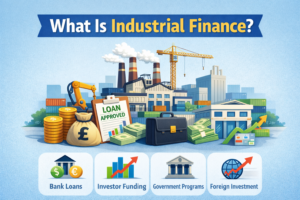
Industrial finance is how factories, manufacturers, and industrial businesses get the money they need to start, operate, and grow.
That covers loans, bonds, equity, government programs, and foreign investment — across every stage of a business lifecycle.
In 2026, it has never been more consequential. The US is seeing $1.595 trillion in reshoring commitments. The UK’s SME lending market hit £68 billion. New government programs on both sides of the Atlantic are actively reshaping who can access capital and on what terms.
Imagine you want to build a factory. You have the idea, the land, and the demand — but no money to buy machines or hire workers. What happens next? This is where industrial finance steps in and turns plans into real production
Key Numbers (2026)
| $1.595 Trillion
US factory investment committed (reshoring) Reshoring Initiative, April 2026 |
£68 Billion
UK SME lending in 2025 — up ~10% British Business Bank, March 2026 |
| 3.5–3.75%
US Federal Reserve rate (held Jan & Mar 2026) Federal Reserve FOMC, 2026 |
3.75%
Bank of England base rate (April 2026) Bank of England, 2026 |
| $5.7 Trillion
Global SME financing gap (unmet need) IFC |
60%
UK SME lending now from challenger banks British Business Bank, 2026 |
What Changed in 2026
A lot has shifted since 2025. Here are the developments that directly affect industrial borrowers in the US and UK.
United States
Federal Reserve — Rates Held Steady
The Fed held rates at 3.5%–3.75% at both the January and March 2026 meetings. Geopolitical uncertainty and elevated energy prices are keeping cuts off the table for now. One reduction is still projected for late 2026 — but it is not guaranteed. For manufacturers, borrowing costs are elevated but predictable.
SBA ‘Made in America’ Loan Guarantee — March 2026
- 90% federal guarantee on loans for manufacturers expanding facilities or hiring
- 7(a) loans up to $950,000: 0% upfront fees for manufacturers
- 504 loans for factory construction: 0% fees through September 2026
- New MARC program — first-ever dedicated revolving credit for US manufacturers
The Reshoring Boom
Tariff citations as a reshoring driver jumped 454% in Q1 2025 vs Q1 2024. By April 2026, $1.595 trillion in factory investments have been pledged to US soil. Average manufacturing wages hit $29.95/hour in March 2026 — the highest on record.
United Kingdom
SME Lending Grows to £68 Billion
UK SME lending rose nearly 10% in 2025, driven by challenger banks. Non-bank lenders now hold 60% of UK SME lending — surpassing the Big Five banks for the fifth straight year. UK non-financial businesses borrowed £30.9bn net in 2025, up from £9.5bn in 2024.
British Business Bank Growth Guarantee Milestone
- £2.5 billion lent under the Growth Guarantee Scheme
- Over £368 million directed specifically to UK manufacturing
- 69% of lending went to businesses outside London and the South East
- BBB firepower boosted by two-thirds at the Spending Review
Bank of England — March 2026 Picture
Manufacturing volumes are still slightly down year-on-year — but the pace of contraction has slowed. Suppliers to defence, renewables, and aerospace are the standout performers. Competition among lenders is increasing, especially for creditworthy borrowers.
Who Provides Industrial Finance?
These are the main institutions shaping the market in 2026.
| Institution | 2026 Role |
| Federal Reserve (US) | Held rates at 3.5–3.75%. One cut projected late 2026. Sets baseline for all US borrowing costs. |
| SBA (US) | Made in America Loan Guarantee launched March 2026. 0% fees on 7(a)/504 manufacturing loans. New MARC revolving credit program. |
| Bank of England (UK) | Base rate 3.75% (April 2026). Manufacturing contraction slowing. Defence, aerospace, renewables showing strength. |
| British Business Bank (UK) | £2.5bn Growth Guarantee milestone. £368m+ to manufacturing. Challenger banks — 60% of SME lending — backed by BBB programs. |
| Commercial Banks (JPMorgan, HSBC, Barclays) | Returning appetite for SMEs in 2025–26. UK non-financial borrowing jumped to £30.9bn net. HSBC backed £11bn UKEF export fund. |
| Challenger Banks (Allica, OakNorth, Starling) | Now 60% of UK SME lending. Faster decisions, more flexible terms — primary alternative to high street banks for manufacturers. |
Types of Industrial Finance
| Type | Duration | Best Use in 2026 | Key Sources |
| Short-term | Under 1 year | Working capital, payroll, inventory | SBA MARC (US), invoice finance, merchant cash (UK) |
| Medium-term | 1–5 years | Equipment, automation, reshoring upgrades | SBA 7(a) 0% fee (US), BBB Growth Guarantee (UK) |
| Long-term | 5+ years | New plants, infrastructure, reshoring | SBA 504 0% fee (US), green bonds, corporate bonds, FDI |
Short-Term Finance
Covers day-to-day operations — raw materials, wages, utilities. With UK SME wages up 8.8% year-on-year and US payroll costs rising, working capital pressure is high. The SBA’s new MARC program (2025/26) is the first revolving credit built specifically for US manufacturers.
Medium-Term Finance
For equipment upgrades, capacity expansion, and hiring. SBA 7(a) loans now carry 0% fees for manufacturers. UK challenger banks are approving BBB-backed loans in as little as 72 hours. This is the most accessible medium-term industrial credit market in a decade.
Long-Term Finance
Major strategic investment — new factories, infrastructure, reshoring. With the Fed at 3.5–3.75% and bond yields still elevated, large manufacturers are being selective about when and how they raise long-term capital. SBA 504 loans are fee-free for manufacturers through September 2026.
Sources of Industrial Finance
Internal Sources
Retained earnings, depreciation funds, and asset sales. These are interest-free — but limited. Apple’s $500B+ US investment and GE Aerospace’s ~$1B commitment are partly funded from retained earnings. Most manufacturers cannot rely on this alone.
Government-Backed Programs
| Program | Country | 2026 Key Terms |
| SBA 7(a) Loan | US | 0% upfront fee for manufacturers up to $950K. 90% federal guarantee. Fast-tracked under $350K. |
| SBA 504 Loan | US | 0% upfront and annual fee for all manufacturing 504 loans in FY2026. Used for buildings, land, machinery. |
| SBA MARC Program | US | New in 2025/26. First dedicated revolving credit for US manufacturers. |
| BBB Growth Guarantee Scheme | UK | £2.5bn milestone. £368m to manufacturing. Government guarantee reduces lender risk. |
| UK Export Finance (UKEF) | UK | HSBC backed £11bn UKEF fund for exporters. Helps manufacturers access global markets. |
Commercial & Challenger Banks
In the US, JPMorgan Chase, Wells Fargo, and Bank of America remain the largest industrial lenders. Manufacturing technology orders hit record highs in early 2026 — and banks are competing for this business.
In the UK, challenger banks (Allica, Starling, OakNorth, Paragon) have taken 60% of SME lending. For manufacturers who cannot get a high street bank loan, challengers are now the primary route.
Capital Markets
- Corporate bonds — NYSE or LSE. Large manufacturers raise billions for reshoring and green manufacturing.
- Equity (IPO/rights issue) — common for rapidly growing industrial tech companies.
- Asset finance — used in 40% of UK business investments in vehicles, machinery, and equipment (FLA, 2026).
Foreign Direct Investment (FDI)
Apple committed $500B+ to US manufacturing. TSMC Arizona is coming online 2025–2026. Tariff policy is actively incentivising foreign manufacturers to build US facilities. In the UK, defence and aerospace exports are strengthening, and the BBB supports late-stage funding for high-growth manufacturers.
What Industrial Finance Does
- Funds new businesses — SBA Lender Match, MARC, and Made in America programs for the US; BBB Start Up Loans for the UK.
- Supports day-to-day operations — working capital, payroll, and inventory between revenue cycles.
- Enables growth — SBA 504 loans and BBB-backed term loans are built for plant expansion and production line additions.
- Funds automation — the BoE’s March 2026 report confirms demand for capital equipment is ‘supported by growing demand for automation.’
- Weathers uncertainty — businesses with diverse funding sources are better positioned against energy price shocks and rate volatility.
- Drives GDP and employment — for every $1 spent in US manufacturing, there is $2.65 of total economic impact (NAM). One manufacturing job generates 4.8 additional jobs across the economy.
Real-World Examples (2026)
US: Small Manufacturer Reshores via SBA
| A small plastics firm in Bay City, Michigan moves production back from China. It needs $800,000 for new equipment and a facility upgrade. |
- Applies through SBA Lender Match — paired with a participating bank within days
- Secures an $800,000 SBA 7(a) loan with 0% upfront fee (saving thousands) and a 90% federal guarantee
- Uses the MARC program for working capital during the transition period
- Outcome: production moves to Michigan, 12 new jobs created, wages up 5.1% in line with national trends
UK: Engineering Firm Funds Automation via BBB
| A precision engineering firm in the West Midlands wants £500,000 for robotics and automation. Its main bank declines due to limited collateral. |
- Applies to a challenger bank backed by the BBB Growth Guarantee Scheme
- Approved within 72 hours — government guarantee offsets the collateral gap
- BoE March 2026 report confirms what the firm is seeing: automation demand is a clear bright spot
- Outcome: output up 35% within 18 months, new defence supply chain contracts, loan repaid over 5 years
US: The Reshoring Investment Wave
The $1.595 trillion in US factory commitments is financed through several layers:
- Large corporations (Apple: $500B+, GE Aerospace: ~$1B) use retained earnings, corporate bonds, and equity
- Mid-sized manufacturers use SBA 504 loans (facility construction) and 7(a) loans (equipment) — both 0% fees in FY2026
- The SBA Working Capital Pilot (WCP) has delivered $150 million to support reshoring manufacturers’ working capital
- Semiconductor and defence manufacturers with up to 1,500 employees now qualify for expanded SBA loan eligibility
UK: Sector Performance Snapshot (March 2026)
| Sector | 2026 Status | Finance Implication |
| Defence & Aerospace | Strong — overseas demand growing | Active borrowing for capacity expansion |
| Renewables Suppliers | Strong demand | Investment-grade financing, green bonds |
| Automotive | Recovering but constrained by EV mandates | Cautious medium-term lending |
| Chemicals | Down amid weak industrial demand | Working capital stress; refinancing needed |
| Consumer Goods & Food | Slightly lower volumes | Trade credit and factoring usage rising |
Source: Bank of England Agents’ Summary of Business Conditions, March 2026.
Challenges in 2026
The UK SME Financing Gap
A £22 billion funding gap still exists for UK SMEs in 2026 (Atlas Credit). SME loan success rates fell from 80% in 2018 to 50% in 2023. The Bank of England’s 2024 SME Finance Survey found 77% of UK SMEs would rather grow slowly than borrow — a structural reluctance to use finance even when it is available.
Interest Rate Pressure
The Fed is at 3.5–3.75% with no clear cut timeline. The BoE is at 3.75% with energy-driven inflation complicating cuts. The effective floating rate for UK SMEs peaked at 8.04% in May 2024. It has fallen since, but remains well above the 2010s norm — and for capital-intensive manufacturers, that directly suppresses investment.
Reshoring Is Expensive
New equipment, facility upgrades, workforce training, and supply chain transitions all require capital. The SBA has responded with fee waivers and new programs — but smaller manufacturers still face real access challenges.
Automation Obsolescence Risk
Equipment financed today may face obsolescence within 5–7 years as AI and robotics advance. This creates a mismatch between loan terms and useful asset life — a tension both lenders and borrowers are navigating.
Key Trends Reshaping Industrial Finance
- Reshoring-Driven Finance (US)
The SBA’s Made in America Loan Guarantee, the MARC program, and the WCP collectively represent the most comprehensive government industrial finance package in US history. Tariff-driven manufacturing pledges have created unprecedented demand for industrial financing.
- Challenger Bank Dominance (UK)
Challenger banks now provide 60% of UK SME bank lending — a complete reversal from a decade ago. Faster decisions, more flexible terms, and genuine sector knowledge make them the primary route for UK manufacturers who cannot get high street bank approval.
- Green and Defence Finance
Both the US and UK are channelling industrial finance into defence and clean energy. UK defence and aerospace suppliers are among the most active borrowers in 2026. In the US, the Inflation Reduction Act continues to fund clean manufacturing through tax credits and low-cost loans.
- AI in Lending
AI is reshaping how industrial finance decisions are made. UK lenders use predictive AI for credit scoring. US fintechs are processing SBA applications faster than ever. The result: manufacturers can access capital in days, not months.
- Energy Prices as a Finance Wildcard
The Middle East conflict in 2026 has pushed energy prices higher — directly affecting manufacturing margins. This makes short-term working capital management more critical, and more urgent, for manufacturers navigating volatile input costs.
Frequently Asked Questions
What is industrial finance in plain terms?
It is how manufacturing and industrial businesses get the money they need to build factories, buy equipment, pay workers, and grow — through loans, government programs, bonds, and investment.
What did the SBA launch for manufacturers in 2026?
The Made in America Loan Guarantee (March 2026), 0% fees on 7(a) loans up to $950K and all 504 loans, and the MARC program — the first dedicated revolving credit for US manufacturers.
What is the BBB Growth Guarantee Scheme?
A UK government-backed scheme that has delivered £2.5 billion to UK businesses, including £368 million to manufacturers. It gives lenders a government guarantee, making it easier to approve loans traditional banks would decline.
Why are challenger banks important for UK manufacturers?
They now provide 60% of UK SME lending, offer 24–72 hour decisions, and are more flexible on collateral requirements — making them the primary medium-term finance route for UK manufacturing SMEs.
What is the global SME financing gap?
$5.7 trillion in SME financing need goes unmet globally. In the UK alone, there is a £22 billion gap in 2026. Government programs like the SBA and BBB exist specifically to fill where commercial lenders will not go.
How does the Federal Reserve affect manufacturers?
The Fed’s rate (3.5–3.75% in April 2026) sets the baseline for all US borrowing costs. One cut is projected for late 2026 — which would modestly lower manufacturing loan costs if it happens.
Can I use an SBA loan to reshore production?
Yes. SBA 7(a) and 504 loans are now specifically designed for reshoring — with 0% fees in FY2026. The SBA’s Made in America program is built exactly for this use case.
Advantages and Disadvantages
| Advantages | Disadvantages |
| Enables large-scale factory construction and reshoring | High borrowing costs when rates are elevated (Fed at 3.5–3.75%) |
| Drives GDP — US manufacturing contributes ~10% of GDP | UK SME loan success rates fell from 80% (2018) to 50% (2023) |
| Supports innovation, automation, and R&D | Long gestation periods create lender risk and financing gaps |
| Government programs (SBA, BBB) fill commercial gaps | Global SME financing gap is $5.7 trillion — market remains underserved |
| Helps businesses survive recessions and supply chain shocks | FDI dependency creates exposure to geopolitical shifts |
| Promotes regional development outside major centres | Equipment can become obsolete within 5–7 years — mismatch with loan terms |
Conclusion
Industrial finance isn’t just a concept — it’s what keeps the real world moving. Every factory that gets built, every machine that starts running, and every job that gets created depends on access to the right funding at the right time. In 2026, with rising costs, global competition, and massive investment shifts, understanding how industrial finance works isn’t optional anymore — it’s essential.
| Whether you are a business owner looking for your funding a student studying industrial economics or a policymaker trying to close the financing gap. Industrial finance is the system you need to understand. |
It determines whether factories get built, whether businesses survive, and whether economies grow.
About the Author
| Javeed Dhillon
Financial Writer & Business Finance Specialist
Javeed Dhillon is a financial writer and SME finance specialist with over a decade of experience covering industrial economics, business lending, and corporate finance across UK and US markets. His work draws on primary data from the Federal Reserve, British Business Bank, Bank of England, SBA, and the IMF. This article was updated in April 2026 to reflect the latest policy changes, interest rate data, and real examples. |