What Are the Types of Industrial Finance
“Industries do not fail because of products. They fail because of poor financial structure.”
Introduction to Industrial Finance
Imagine a steel plant sitting idle. The company has materials, workers are ready and orders are piling up. Nothing moves because the company ran out of working capital. That is what happens when industrial finance breaks down.
Industrial finance refers to the system of providing resources to industrial enterprises. It helps them establish, operate, expand and modernize their businesses. In 2026, understanding the types of finance is critical — global supply chains are rebuilding, green energy transitions require capital, and manufacturing is returning to domestic markets across the US, Europe and Asia.
What Is Industrial Finance
Industrial finance is the provision of capital and financial services to fund the production activities of enterprises — constructing factories, purchasing machinery, procuring materials, paying wages and funding R&D projects. Unlike retail banking, industrial finance deals with large-scale operations with complex risk profiles and significantly larger amounts.
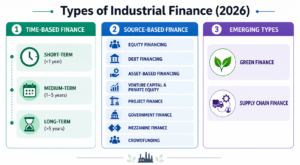
The Main Classification of Industrial Finance
- Equity Financing
- Debt Financing
- Asset Based Financing
- Venture Capital and Private Equity
- Project Finance
- Government and Institutional Finance
- Mezzanine Finance
- Crowdfunding and Alternative Finance
Part 1: Time-Based Types of Industrial Finance
Short Term Industrial Finance
Short term finance covers working capital needs for periods less than one year — purchasing materials, paying wages and utility bills.
| Source | Description | Duration |
|---|---|---|
| Bank Overdraft / Cash Credit | Revolving credit limit | Rolling / reviewed annually |
| Trade Credit | Suppliers extend payment terms | 30–90 days |
| Working Capital Loans | Loans for operational expenses | 3–12 months |
| Invoice Discounting / Factoring | Selling receivables to a financier | Immediate to 90 days |
| Customer Advances | Pre-payments from buyers | Varies |
| Commercial Paper | Unsecured short term debt | 7–270 days |
Example (2026): A textile manufacturer in Bangladesh used invoice factoring to fund cotton yarn purchases and pay workers, keeping production on schedule without disrupting cash position.
Medium Term Industrial Finance
Medium term finance bridges working capital needs and major capital investment for periods of 1–5 years. Used for projects that are significant but don’t require extended repayment timelines.
Key sources: term loans from banks, debentures, hire purchase or leasing, retained earnings, development bank loans, private placement of bonds.
Example (2026): A mid-sized auto parts manufacturer in Mexico secured a 3-year term loan covering 70% of a stamping line upgrade, increasing output by 28%.
Long Term Industrial Finance
Long term finance is the foundation for heavy industry and large-scale manufacturing. Covers periods exceeding 5 years — for constructing factories, purchasing industrial machinery and establishing greenfield projects.
Key sources: equity shares, corporate bonds, development bank loans, retained earnings, mortgage loans, foreign currency loans, pension/insurance fund investments.
Example (2026): TSMC’s Arizona fab exceeds $65 billion — financed through equity, US government grants, and long-term debt from a bank consortium.
Part 2: Types Based on Instruments
Equity Financing
Equity financing is raising money by selling ownership stakes. No repayment required, but investors get a say in operations.
Forms of Equity Finance
- Public Equity — Selling shares on a stock market
- Private Equity — Selling to private investors
- Rights Issues — Giving existing investors the chance to buy more shares
- Venture Capital — Investors fund growing companies in exchange for ownership
| Feature | Detail |
|---|---|
| Repayment? | No (dividends may be expected) |
| Ownership impact | New investors dilute existing ownership |
| Investor risk | High — last in line if company fails |
| Flexibility | Very high — fewer restrictions |
Example (2026): A German green hydrogen company raised €450 million via IPO to build a factory, choosing equity to avoid heavy debt during early growth phase.
Debt Financing
Debt financing is borrowing money with repayment obligations plus interest. The most common funding method for industrial companies.
Types of Debt Financing
- Bank Loans — Borrow from a bank, repay over time
- Corporate Bonds — Borrow from investors with a fixed return promise
- Syndicated Loans — Group of banks share a large loan
- Revolving Credit — Access funds as needed, repay and re-borrow
- Subordinated Debt — Repaid after senior loans if company fails
| Dimension | Debt Finance | Equity Finance |
|---|---|---|
| Repayment? | Yes, with interest | No |
| Ownership impact | None | Dilution occurs |
| Tax treatment | Interest is tax deductible | Dividends are not |
| Cost | Usually lower interest rate | Hard to quantify |
| Risk | Increases obligations | Decreases obligations |
Example (2026): A US robotics company issued $500 million in bonds over 10 years — cheaper than alternatives, with tax-deductible interest payments.
Asset-Based Financing
Asset-based financing uses company assets (buildings, equipment) as collateral to secure a loan — lenders look at asset value rather than company earnings.
Types
- Asset-Based Loans — Company assets used as security
- Equipment Financing — Equipment itself is the collateral
- Sale-and-Leaseback — Sell an asset, then lease it back
- Inventory Financing — Stock used as collateral
- Invoice Discounting — Sell invoices for immediate cash
Example (2026): A Finnish paper mill raised €80 million through a sale-and-leaseback of its building to fund equipment upgrades — without adding debt to its balance sheet.
Venture Capital and Private Equity
Venture Capital
For fast-growing, early-stage companies. Investors provide funds in exchange for ownership stakes, typically in technology-focused companies.
Private Equity
For established companies. Investors buy a significant stake (sometimes the entire company) to improve efficiency and drive growth.
| Dimension | Venture Capital | Private Equity |
|---|---|---|
| Company stage | New and growing | Already established |
| Ownership | Partial | Larger share / whole company |
| Focus | Innovation, fast growth | Efficiency, scaling |
| Holding period | 5–10 years | 3–7 years |
| Risk level | Very high | Medium to high |
Example (2026): A US battery company raised $320 million in VC funding to scale production and supply EV manufacturers.
Project Finance
Project finance funds large industrial projects (power plants, roads, industrial parks) where lenders are repaid only from the project’s own revenues — not the company’s general funds.
How It Works
Sponsoring Company
↓ Special Purpose Vehicle (SPV) — project-only entity ↓ Project Assets (e.g., power plant) ↓ Revenue from project (e.g., selling power) ↓ Lenders repaid → Sponsors receive surplus
Key Characteristics
- Off-balance-sheet for sponsors
- Project needs revenue contracts (offtake agreements)
- Typical duration: 15–25 years
- Risk is shared among all participants
Example (2026): A major Middle East solar project secured $1.2 billion from a bank consortium via project finance structure.
Government and Institutional Finance
Governments and development institutions support sectors, backward regions and projects that are commercially important but may not yet attract purely commercial lenders.
Forms
- Development Bank Loans — IDBI, KfW, US DFC — long-term loans at preferential rates
- Government Grants and Subsidies — Non-repayable, tied to policy goals (jobs, regions, clean energy)
- Export Credit Agency (ECA) Financing — US EXIM, UK Export Finance, JBIC — loans and guarantees for exports
- Multilateral Development Banks (MDB) — IFC, ADB, AfDB — financing for emerging markets
- Tax Incentives and Accelerated Depreciation — Reduces effective cost of capital
Example (2026): Intel received $7.86 billion in US government grants to fund semiconductor factory construction in Arizona and Ohio.
Mezzanine Finance
Mezzanine finance sits between debt and equity in the capital stack. It combines features of both — higher interest than senior debt, but may include equity conversion rights.
Capital Stack Position
| Level | Risk | Return |
|---|---|---|
| Senior Secured Debt | Lowest | Lowest |
| Senior Unsecured Debt | Low | Low |
| Mezzanine Finance | Medium-High | Medium-High |
| Preferred Equity | High | High |
| Common Equity | Highest | Highest |
Example (2026): A European industrial packaging company received €60 million mezzanine at 11% with equity warrants to fund an acquisition without over-diluting founders.
Crowdfunding and Alternative Finance
Increasingly popular for SMEs, especially in energy, sustainable manufacturing and technology sectors.
Forms
- Equity Crowdfunding — Small investors buy stakes via regulated platforms
- Debt Crowdfunding (P2P Lending) — SMEs borrow from crowds via platforms like Funding Circle
- Revenue-Based Financing — Investors get % of revenue until a cap is reached; no equity or debt
- Green Bonds via Crowdfunding — Smaller green projects issue ESG-labelled bonds
Example (2026): A UK industrial hemp company raised £2.4 million via equity crowdfunding from 1,800+ investors, many of whom were existing customers.
Part 3: Specialized and Emerging Types (2026)
Green and Sustainable Industrial Finance
Encompasses green bonds, sustainability-linked loans, green project finance and carbon credit finance. Global green bond issuance is growing rapidly, driven by ESG mandates and the energy transition. Industrial companies aligned with sustainability goals gain access to cheaper capital.
Supply Chain Finance (Reverse Factoring)
Technology-enabled solutions that optimize cash flows. An anchor buyer leverages its credit rating to help suppliers receive early invoice payments at lower costs.
- Suppliers — access cash at competitive rates
- Buyers — extend payment terms without harming supplier relationships
- Banks/Fintechs — earn a spread for facilitating transactions
Example (2026): A European automotive OEM enabled 800+ suppliers to access early payment at rates 150–200 basis points below their own borrowing costs, while extending its own payables from 45 to 75 days.
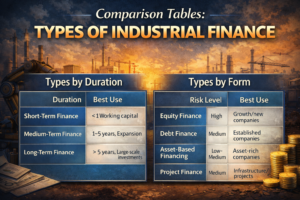
Comparison Table: All Types at a Glance
| Type | Duration | Risk | Best For | Key Advantage | Key Disadvantage |
|---|---|---|---|---|---|
| Short-Term Finance | < 1 year | Low–Med | Working capital | Fast and flexible | Must repay quickly |
| Medium-Term Finance | 1–5 years | Medium | Equipment, expansion | Structured repayment | May require collateral |
| Long-Term Finance | > 5 years | Med–High | Greenfield, capex | Aligns with asset life | Complex and expensive |
| Equity Finance | Permanent | High | Growth, early stage | No repayment | Ownership dilution |
| Debt Finance | Fixed term | Medium | Established companies | Tax deductible | Repayment obligation |
| Asset-Based Finance | Varies | Low–Med | Asset-rich companies | No equity needed | Asset risk |
| Project Finance | 15–25 years | Medium | Large infrastructure | Off-balance-sheet | Complex to arrange |
| Mezzanine Finance | 3–7 years | Med–High | Acquisitions, buyouts | Fills funding gap | Higher interest cost |
| Govt / Institutional | Long | Low | Strategic sectors | Preferential rates | Bureaucratic process |
| Crowdfunding | Varies | High | SMEs, niche sectors | Wide investor base | Not for large amounts |
Frequently Asked Questions
What is industrial finance?
Industrial finance is when companies get the money they need to start, run and grow their businesses through specialized instruments suited to large-scale production operations.
What are the main time-based types?
Short-term (less than 1 year), medium-term (1–5 years), and long-term (more than 5 years).
What is the difference between equity and debt?
Equity is selling part of the company — no repayment needed. Debt is borrowing money that must be repaid with interest.
What is project finance?
A structure where a project (e.g., power plant) is financed through a separate entity, and lenders are repaid only from the project’s revenues.
What is mezzanine finance?
A hybrid of debt and equity used when senior debt capacity is exhausted but the company doesn’t want to fully dilute ownership.
What is green industrial finance?
Finance directed toward environmentally friendly industrial projects — renewable energy, clean manufacturing, and sustainability-linked operations.
What is the best type for a new manufacturer?
Equity finance is usually best early on — no immediate repayment pressure while the company establishes cash flows
About the Author
Javeed Dhillon writes about industrial finance in a way that actually makes sense.
He focuses on how businesses really get funded — not just the theory, but what happens on the ground when companies try to raise money, manage cash flow, or scale operations. His work covers everything from working capital and bank loans to project finance, private equity, and newer models like green finance and fintech lending.
Over the years, he has studied how industrial businesses succeed or fail based on their financial decisions. A lot of companies don’t fail because of bad products — they fail because they structure their finances poorly. That’s the gap his work tries to fix.
Instead of overcomplicating things, he breaks complex financial topics into clear, practical explanations that business owners, students, and professionals can actually use.
His writing is especially useful for:
- People trying to understand how industrial finance works in real life
- Business owners figuring out funding options
- Students who are tired of textbook-style explanations
In 2026, where financing options are evolving fast — from traditional bank loans to ESG funding and alternative finance — his focus remains simple: help people make smarter financial decisions without the noise.